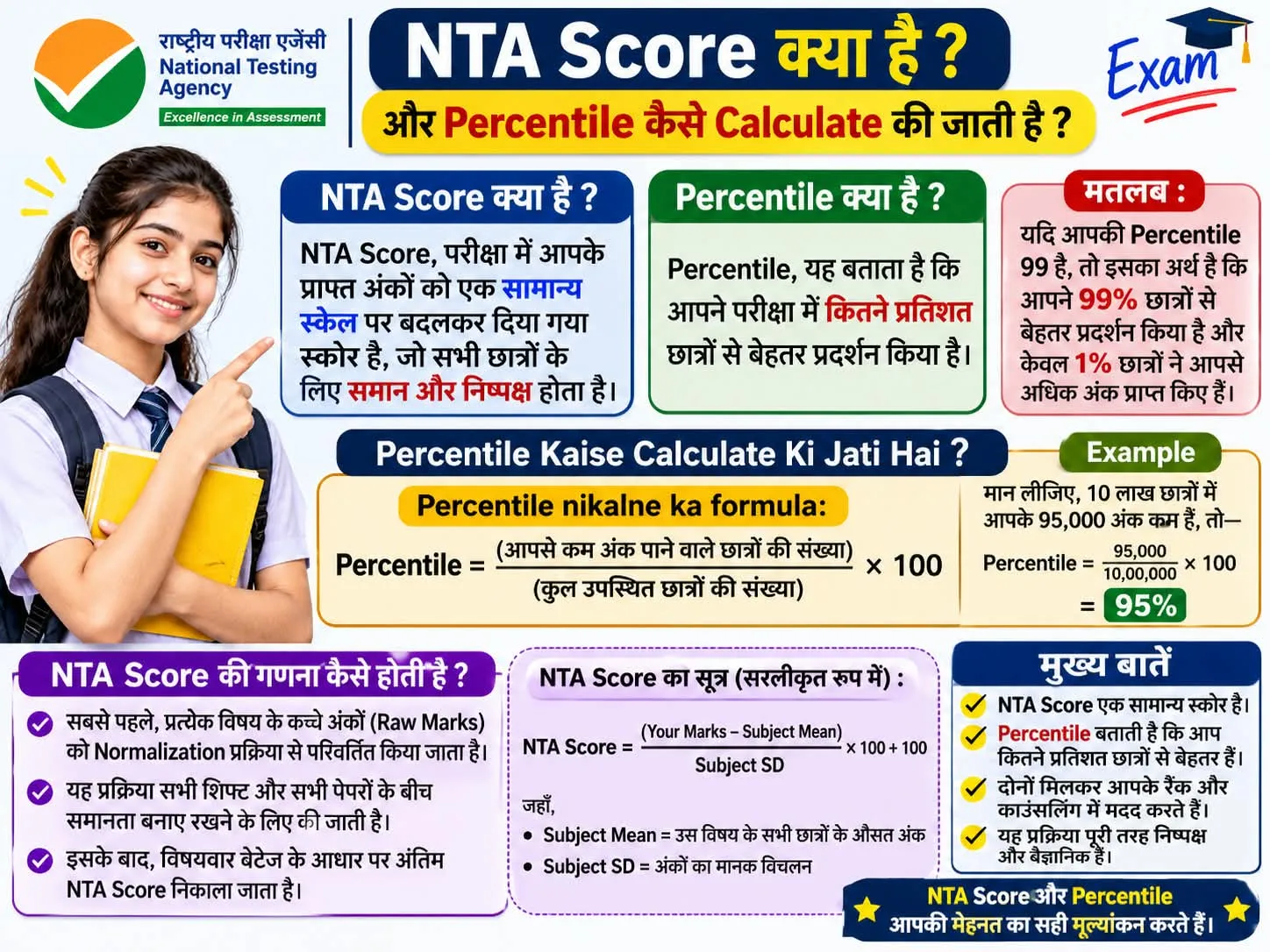

Indian competitive examinations—jaise JEE Main, NEET, aur CUET—ke evaluation ecosystem mein NTA Score aur Percentile ko aksar percentage ke saath confuse kar liya jata hai. Analytical aur statistical perspective se dekhein toh percentage ek absolute metric hai (total marks mein se aapne kitne score kiye), jabki NTA Score ek relative psychometric normalization metric hai. Yeh aapki individual capability ko nahi, balki ek specific exam shift ke andar baaki competitors ke muqable aapki standing ko measure karta hai.
Jab koi bada exam multiple days aur alag-alag shifts mein conduct hota hai, toh har shift ke question paper ka difficulty level thoda alag hona swabhavik hai. Agar evaluation sirf raw marks par hoga, toh easy shift wale candidates ko unfair advantage milega. Is structural bias ko khatam karne ke liye National Testing Agency (NTA) Normalization Procedure ka istemal karti hai, jiska final output NTA Score kehlata hai.
Iski mathematical architecture aur calculation process ko hum chaar mukhya hisson mein samajh sakte hain:
1. Session-Wise Isolation (Shift-Level Benchmarking) NTA sabse pehle har shift (session) ko ek independent cohort maanta hai. Aapke marks ki tulna poore desh ke candidates se seedhe nahi hoti, balki sirf unhi candidates se hoti hai jinhone aapki exact shift mein exam diya hai. Har shift ke topper ko default roop se 100.0000000 NTA Score assign kiya jata hai, chahe uske raw marks 300 mein se 285 hon ya 260.
2. The Exact Percentile Formula Aapka NTA Score nikalne ke liye ek strict statistical formula apply kiya jata hai:
$$\text{NTA Score} = \frac{100 \times \text{Number of candidates in the session with raw score } \le \text{ your score}}{\text{Total number of candidates who appeared in that session}}$$
Udaharan ke liye, agar aapki shift mein 1,00,000 students baithe aur aapke marks 92,500 students ke barabar ya unse zyada hain, toh aapka NTA Score 92.5000000 hoga.
3. 7-Decimal Precision (Tie-Breaking Architecture) Bade exams mein lakhon candidates hone ke karan ek hi percentile par hazaron students aa sakte hain. Is bunching effect aur tie-breaking friction ko kam karne ke liye NTA apne score ko 7 decimal places (e.g., 98.4567123) tak calculate karta hai. Isse merit list mein ranking allot karna zyada granular aur accurate ho jata hai.
4. Multi-Session Merging aur Final Merit Jab exam multiple sessions mein hota hai, toh har shift ke sabhi candidates ke raw scores ko pehle unke respective NTA Scores (percentiles) mein convert kiya jata hai. Ek baar jab saara data ek hi statistical scale (0 se 100) par aa jata hai, tab sabhi shifts ke NTA Scores ko merge karke All India Rank (AIR) taiyar ki jati hai. Agar koi candidate do attempts deta hai, toh uska best of two NTA Score final merit ke liye consider hota hai.
Antatah, NTA Score ek aisa statistical equalizer hai jo paper ki difficulty ke utaar-chadhav ko neutralize karke ek fair, normalized merit list ensure karta hai.