

Ramesh Kumar
Ramesh Kumar· 9 दिन पहले
लेखक

Gap year ke baad JEE de sakte hain kya?

1
37

इस बातचीत में शामिल हों

क्रमबद्ध करें
ऊपर दिए गए सवाल का जवाब
अपडेट किया गया11/12/26

Ha , Gap year ke baad JEE de sakte hai . JEE main or JEE Advance in dono ke liye Gap year me exam dene ka ruls alag hote hai jaise yadi 12th ke baad apne 1 year ka gap liya to bhi aap JEE main exam de sakte hai kyuki yah pariksha 1 year me do baar hoti hai .12th ke baad lagatar 3 saal tak aap is pariksha ko aap de sakte hai .3 saal me 6 baar yah pariksha hoti hai lekin JEE Advance me iske ruls change ho jaate hai .iske hisab se 12 ke baad do saal tak hi aap JEE Advance ki pariksha de sakte hai.JEE Main ke liye koi aayu seema nirdharit nahi hai. Lekin JEE Advance ke liye yah niyam alag hai; isme student ka janam 1 October 2002 me ya uske baad hua hona chahiye yah EWS /GEN/OBC cast ke students par lagu hota hai. Lekin SC/ST wale students ke liye yahi patrata 1 October 1997 me janam liye ya uske baad janam liye students par lagu hoti hai.SC/ST/ PWD cast walo ko 5 year ka benefit milta hai. Form bharte samay Gap certificate ki koi jarurat nahi hoti hai, lekin exam me selection ke baad college selection ki counselling ke baad jo document verification hota hai usme iski jarurat pad sakti hai.JEE ka result percentile ya NTA ke dvara ghoshit kiya jata hai.

JEE Main OR JEE Advance me difference -

JEE Main - 12th ke baad lagatar 3 saal tak diya ja sakta hai; yadi aapne 12 ke baad 1 saal ka Gap liya hai to aap agle 2 saal tak Exam de sakte hain. isme koi age limit nahi hoti hai .JEE Mains ke liye 12 me percentage ki koi badhyta nahi hoti hai.

JEE Advance - JEE Advance me 12 ke baad 2 saal tak hi aap exam de skte hai .isme JEE Advance me 12th me 75% hona chahiye or sc /st or pwd Cast ke students ke liye 65% hona chahiye.JEE Advanced ke liye 2 baar hi chance milta hai. Yah pariksha ek hi din me do shifto me aayojit ki jaati hai our niyam ke anusar yah dono shifto ki pariksha dena anivary hota hai.JEE ki pariksha ek entrance exam hota hai jo ki engineering college me admission ke liye bahut hi jaruri hota hai. Is pariksha ki taiyaari ke liye vidyarthiyon ko lagataar mehnat karni chahiye.
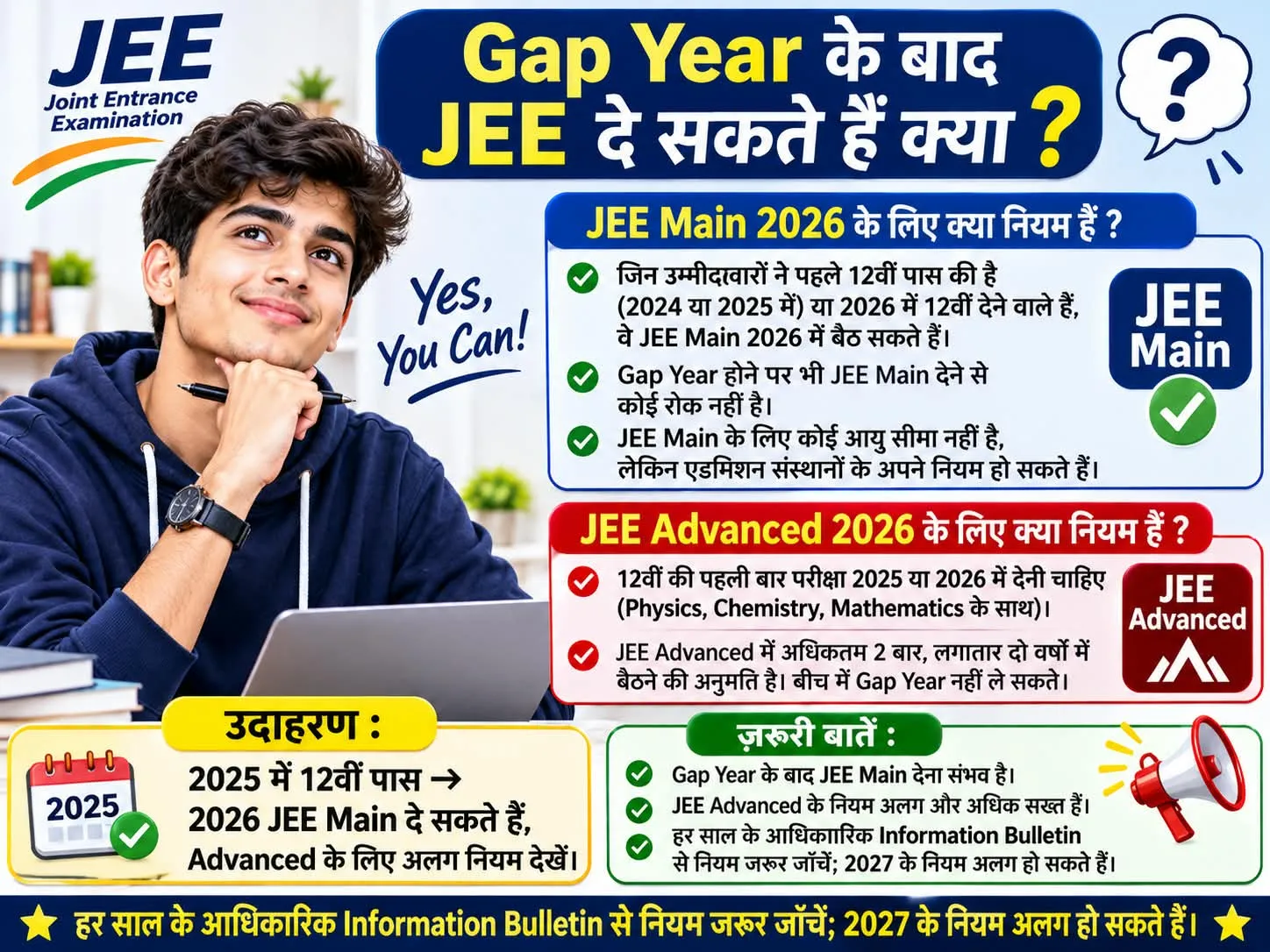

लेख की तस्वीर

komal Solanki
लेखक
प्रोफ़ाइल देखें

🔍 Seeking answers & sharing perspectives 🌍 Turning thoughts into meaningful blogs

0
ऊपर दिए गए सवाल का जवाब
अपडेट किया गया11/05/26

Quick Answer: Haan, bilkul! Gap year JEE eligibility ka seedha rule: JEE Main ke liye koi age limit nahi hai, aur 12th pass karne ke baad lagatar 3 saal tak exam de sakte ho. JEE Advanced sirf 2 lagatar saal mein. Matlab 1 gap year mein dono, 2 gap years mein sirf JEE Main.

“Beta, drop loge toh career kharab ho jaayega!” Yeh line har dropper ne kisi rishtedaar se suni hai. Sach yeh hai ki bahut se students drop year ke baad hi IIT aur NIT pahunchte hain. Bas rules pata hone chahiye.

JEE Main vs JEE Advanced: Rules Ek Nazar Mein

Rule

JEE Main

JEE Advanced

Age limit

Koi nahi

Hai (2026: General ke liye janm 1 Oct 2001 ya baad)

Kitne saal

3 lagatar saal

2 lagatar saal

Har saal attempts

2 sessions

1

Kul maximum attempts

6

2

Pehle kya chahiye

Class 12 (eligible year)

JEE Main Paper 1 mein top 2,50,000

JEE Main 2027: Kaun De Sakta Hai?

  • JEE Main 2027 ke liye woh eligible hain jinhone Class 12 2025 ya 2026 mein pass kiya, ya 2027 mein de rahe hain.

  • Gap year lene se eligibility reset nahi hoti.

  • Improvement exam dene se original 12th passing year nahi badalta.

Note: NTA ne JEE Main 2027 ka Information Bulletin 24 October 2026 ko jaari kiya; final rules wahan padhiye.

JEE Advanced Ki Extra Shartein

  • Sirf do attempts, do lagatar saalon mein, har saal ek.

  • 2026 ka age rule: General ke liye janm 1 October 2001 ya baad, SC/ST/PwD ke liye 1 October 1996 ya baad (5 saal ki chhoot).

JEE 2027 Ke Liye

12th Pass Year

Gap Years

JEE Main 2027

JEE Advanced 2027

2027 (appearing)

0

Haan

Haan (pehla attempt)

2026

1

Haan

Haan (aakhri attempt)

2025

2

Haan (aakhri saal)

Nahi

2024 ya pehle

3+

Nahi

Nahi

Admission Ke Liye Marks Ka Rule

Category

Class 12 Mein Minimum

General/OBC/EWS

75% ya top 20 percentile

SC/ST/PwD

65% ya top 20 percentile

Dropper Ke Liye Desi Survival Tips

  • Drop ka plan likhit mein banaiye: mahine-wise syllabus aur mock tests.

  • Har hafte ek full-length mock test dijiye aur galtiyon ki diary rakhiye.

  • Social media ko “uninstall” kijiye, “kal se” wala vaada kaam nahi karta.

  • Backup rakhiye, jaise state engineering exams ya BITSAT.

  • Rishtedaaron ke sawaalon ka ek hi jawab: “Tayyari chal rahi hai, result pe milte hain!”


Gap year failure nahi, doosra mauka hai. Bas ghadi yaad rakhiye: JEE Main ke liye 3 saal, JEE Advanced ke liye sirf 2. Drop lijiye, par poore plan ke saath!

Sources:

Tara Verma
लेखक
प्रोफ़ाइल देखें

Tara Verma is a practising teacher and education content writer with over 10 years of classroom experience across primary and secondary levels. She holds a Master's degree in Education (M.Ed.) from Delhi University and a Bachelor of Education (B.Ed.) from Jamia Millia Islamia — qualifications that ground her writing in both pedagogical theory and the day-to-day realities of teaching in India. Her content covers exam preparation strategies, learning methodologies, curriculum guidance, student mental health, career counselling for students, and the evolving state of school and higher education in India. Her work has appeared on platforms including TeacherVision India, Jagran Josh, and Careers360, where she writes for students, parents, and fellow educators who need content built on actual teaching experience — not theory alone. Over a decade of working directly with students across age groups and learning levels has given Tara a practical understanding of how education content should be written — clearly, accessibly, and with genuine awareness of the challenges students and teachers face on the ground. She has taught 1,000+ students, contributed to school curriculum development initiatives, and published 250+ articles on education across digital platforms. She is an active member of the National Council of Teachers of English (NCTE) India. Across all her writing, every recommendation is classroom-tested, every insight comes from direct teaching experience, and every article is held to the same standard she applies in her own classroom — accuracy, clarity, and genuine usefulness for the reader.

0